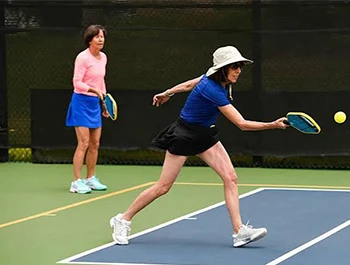
Pickleball has quickly become a popular paddle sport among players of different ages and skill levels. Combining elements of tennis, badminton, and table tennis, it offers an engaging balance of strategy, coordination, and physical activity. The game is relatively easy to learn, making it an excellent choice for beginners, families, recreational players, and sports enthusiasts.
However, before stepping onto the court, it is important to understand the basic rules. Knowing how to serve correctly, following the two-bounce rule, respecting the kitchen zone, and keeping track of the score will help you play with greater confidence.
In this guide, we will explain how to play pickleball step by step, helping you understand the essential rules and get ready for your first match.
1. Understanding the Basics of Pickleball
Pickleball is played on a rectangular court divided by a net. Players use solid paddles to hit a lightweight, perforated plastic ball over the net and into the opponent's court.
The game can be played in two formats:
Singles: One player competes against one opponent.
Doubles: Two players form a team on each side of the net.
Doubles is a particularly popular format because it encourages teamwork, communication, and coordinated positioning.
The objective is to hit the ball into the opponent's court in a way that prevents them from returning it legally. A rally continues until one side commits a fault, such as hitting the ball out of bounds, allowing it to bounce twice, or violating a serving or kitchen rule.
To start playing, you do not need to master every advanced technique. Focus on the four fundamental rules below, and the rest of the game will become much easier to understand.
2. Pickleball Serving Rules: How to Start a Rally
Every rally begins with a serve. Unlike tennis, pickleball uses an underhand-style serve or an approved drop serve, depending on the serving technique chosen.
A legal serve must follow specific requirements regarding the serving motion, court position, and ball placement.
2.1 How to Serve Correctly
In a traditional volley serve, the server must follow these basic requirements:
Use an underhand motion: The paddle must move upward when striking the ball, and contact must be made below the waist under the standard volley-serve rules.
Keep the paddle head properly positioned: At the moment of contact, the highest point of the paddle head must not be above the wrist joint.
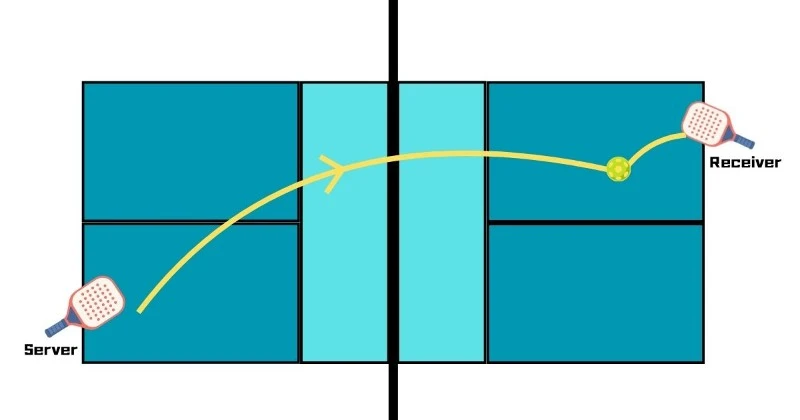
Serve diagonally: The ball must travel over the net and land in the diagonally opposite service court.
Stay behind the baseline: At the moment the ball is struck, the server must not touch the baseline or the court inside it with either foot.
Avoid the kitchen: A serve that lands in the non-volley zone, including its boundary line, is a fault.
Players may also use the drop serve. For this technique, the ball is released from the hand and allowed to bounce naturally before being struck. The restrictions specific to the traditional volley serve do not apply in the same way to a drop serve.
2.2 Where Should the Serve Land?
The serve must land in the opponent's diagonally opposite service court. The kitchen and its boundary lines are excluded from the valid service area.
If the ball lands on a sideline or baseline that forms part of the service court boundary, it is generally considered in. However, a ball that lands on the kitchen line is a fault because that line belongs to the non-volley zone.
A serve that touches the net but still lands in the correct service court is generally playable under current standard rules. It does not automatically become a fault simply because it touches the net.
2.3 Serving Rotation in Singles and Doubles
In singles, the server's position determines the serving side: an even score means serving from the right side, while an odd score means serving from the left side.
In doubles, both teammates normally have an opportunity to serve during a team's service turn, with an exception for the first service turn of the game. After a serving fault ends the applicable service turn, the serve passes to the opposing team.
Players must also follow the correct serving sequence and maintain the proper server position. Incorrect positioning or serving out of turn can result in a fault under the applicable rules.
Beginner tip: Do not focus on power when learning to serve. Prioritize consistency, legal technique, and accurate placement. A controlled serve that lands deep in the correct service court can be more effective than a hard serve that frequently goes out.
3. The Two-Bounce Rule: Why the First Two Returns Matter
The two-bounce rule is one of the most important features that distinguishes pickleball from many other paddle and racket sports.
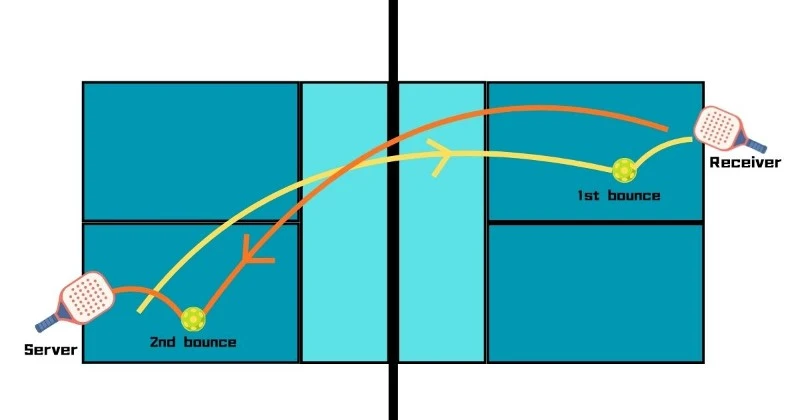
It requires the ball to bounce once on each side before either team may legally volley it.
3.1 How the Two-Bounce Rule Works
The sequence is straightforward:
The serving team hits the ball over the net.
The receiving team must allow the serve to bounce once before returning it.
The serving team must then allow that return to bounce once before hitting it back.
After these two required bounces have occurred, either team may volley the ball or play it after a bounce, subject to the kitchen rules.
A volley means hitting the ball before it touches the ground.
For example, if you serve to your opponent, they cannot immediately hit the ball out of the air. They must let it bounce first. When they return it, your team must also let the ball bounce before playing the next shot.
Once both sides have completed their required bounce, the rally can develop into faster exchanges at the net.
3.2 Why Does Pickleball Have a Two-Bounce Rule?
Without this rule, the serving team could rush toward the net immediately after serving and gain a significant positional advantage.
Requiring a bounce on each side creates a more balanced start to the rally. It gives the receiving team time to return the serve and prevents the serving team from attacking too aggressively at the beginning.
It also encourages players to develop groundstrokes, placement, and court positioning rather than relying entirely on quick volleys.
Beginner tip: Remember the sequence: serve, bounce, return, bounce, then play freely. If you hit the ball before the required bounce, you commit a fault.
4. The Kitchen Rule: Understanding the Non-Volley Zone
The kitchen, officially known as the non-volley zone (NVZ), is the seven-foot area on both sides of the net. It extends across the full width of the court.
This area is especially important during fast exchanges near the net because it limits the use of aggressive volleys from close range.
4.1 What Is Allowed in the Kitchen?
Players may enter the kitchen and hit the ball after it has bounced inside the zone. They can also stand in the kitchen when the ball is not being volleyed.
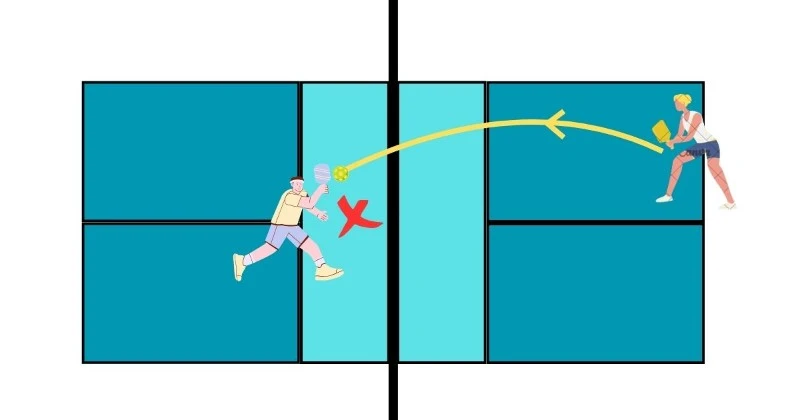
The key restriction is that a player must not volley the ball while standing in the kitchen or touching its boundary line.
The rule also covers momentum. If you volley the ball outside the kitchen but your movement carries you into the kitchen afterward, that is a fault. The fault still applies if your momentum carries you into the kitchen after the volley, even if the ball has already become dead.
Players must regain their balance and establish a legal position before volleying again.
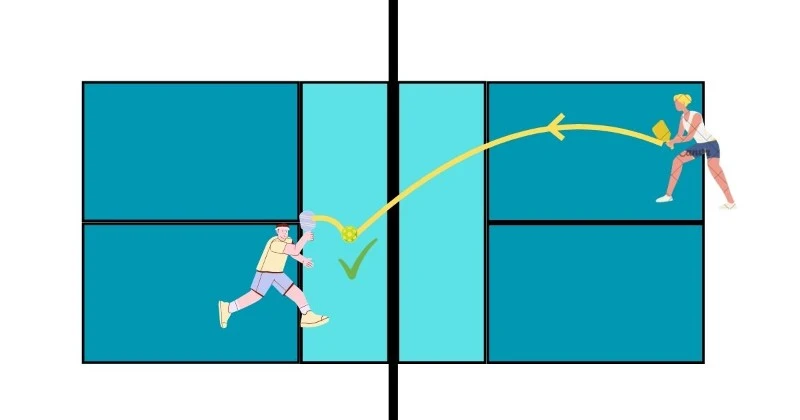
4.2 Can You Hit a Ball That Bounces in the Kitchen?
Yes. The kitchen is not a forbidden area for all shots.
If the ball bounces inside the kitchen, you may step into the zone and hit it. This is common when responding to a short shot, especially a dink.
A dink is a soft shot intended to land in the opponent's kitchen, forcing them to move forward and play the ball after it bounces.
The distinction is simple:
Volleying in the kitchen: Not allowed.
Hitting a ball after it bounces in the kitchen: Allowed.
Standing in the kitchen when you are not volleying: Allowed.
4.3 Why Is the Kitchen Rule Important?
The kitchen rule prevents players from dominating every rally with powerful volleys directly above the net. Instead, it rewards control, patience, accurate placement, and tactical shot selection.
Experienced players often use soft dinks to create openings, move their opponents out of position, and wait for a less controlled return before attacking.
For beginners, learning to move forward safely, maintain balance, and recognize when to use a soft shot can make a significant difference.
Beginner tip: Do not assume you must stay outside the kitchen at all times. You can enter it when appropriate, but never volley while touching the kitchen or its line.
5. How to Score in Pickleball
Pickleball scoring may seem confusing at first, particularly in doubles, where the score includes three numbers. Once you understand who can score and how the serving sequence works, it becomes much easier.
5.1 Traditional Scoring: Only the Serving Team Scores
Under traditional side-out scoring, only the serving team can earn a point.
If the serving team wins a rally, it scores a point and continues serving, with the serving position changing according to the rules.
If the serving team loses the rally, it loses its service opportunity. In doubles, the serve generally passes to the second server on the same team before transferring to the opposing team, except at the beginning of the game, when the first serving team has only one service turn.
The receiving team does not score a point simply by winning a rally under traditional scoring. Instead, it gains the opportunity to serve.
5.2 What Do the Three Numbers Mean in Doubles?
In traditional doubles scoring, the score is announced using three numbers:
Serving team's score – Receiving team's score – Server number
For example, a score of 5–3–2 means:
The serving team has 5 points.
The receiving team has 3 points.
The second server on the serving team is serving.
At the beginning of a traditional doubles game, the score is announced as 0–0–2. This reflects the special opening service turn, in which the first serving team has only one server before the serve passes to the opponents.
This system helps players identify both the current score and which teammate is responsible for serving.
5.3 When Does a Pickleball Game End?
Traditional recreational games are commonly played to 11 points, and a team must win by at least two points.
For example, a score of 11–9 ends the game, but a score of 11–10 does not. Play continues until one team leads by two points, such as 12–10 or 13–11.
Some competitions use different target scores, including 15 or 21, depending on the event format and governing rules. Always check the rules for your particular match.
5.4 What About Rally Scoring?
Rally scoring is another format used in certain pickleball competitions and formats. Under rally scoring, a point may be awarded to the team that wins the rally, regardless of which team served.
However, traditional side-out scoring remains an important format to learn, especially for recreational doubles. Do not assume every tournament uses the same scoring system.
Beginner tip: Before a game starts, confirm the target score and scoring format. In doubles, practice calling all three numbers clearly to avoid confusion about the serving order.
6. What Counts as a Fault in Pickleball?
A fault is an action that violates the rules and ends the rally or otherwise results in the applicable penalty.
Common faults include:
- Serving into the net or outside the correct service court.
- Hitting the ball out of bounds.
- Allowing the ball to bounce twice on your side before returning it.
- Volleying before the two-bounce requirement has been satisfied.
- Volleying while touching the kitchen or its boundary line.
- Being carried into the kitchen by momentum after a volley.
- Violating the applicable serving or positioning requirements.
A ball that strikes the net during a rally is not automatically a fault. If it crosses the net and lands legally in the opponent's court, play can continue. If it fails to cross the net or lands out of bounds, the appropriate fault applies.
Similarly, a ball that clips the net cord and still lands in bounds can remain in play. What matters is where the ball lands and whether the shot complies with the rules, not simply whether the ball touched the net.
Understanding these distinctions helps beginners avoid unnecessary arguments and make more confident decisions during a match.
7. Five Practical Tips for Pickleball Beginners
Knowing the rules is only the first step. Developing good habits will help you enjoy the game and improve more quickly.
7.1 Prioritize Consistency Over Power
Beginners often try to hit every ball as hard as possible. However, pickleball rewards controlled placement and patience. Focus on keeping the ball in play before attempting difficult attacking shots.
7.2 Learn to Position Yourself After Serving
After serving, prepare for the next shot instead of remaining stationary. In doubles, coordinate with your partner and move together when appropriate, while remembering the two-bounce rule.
7.3 Practice Soft Shots
Dinks and other controlled shots are important tools for managing rallies around the kitchen. Practice directing the ball low over the net and landing it inside the opponent's non-volley zone.
7.4 Communicate With Your Partner
In doubles, communication reduces confusion over who should return a shot. Simple calls such as "mine," "yours," and "out" can help your team maintain better court coverage.
7.5 Choose Equipment That Matches Your Skill Level
Your paddle affects how you control the ball, generate power, and respond during fast exchanges. Beginners may benefit from a paddle that offers a comfortable grip, manageable weight, and a balance of control and power.
Ball selection also matters. Outdoor pickleballs generally have smaller holes and a harder construction than indoor balls, helping them perform in windy conditions. Use equipment appropriate for your playing environment and the relevant rules.
8. Final Thoughts: Start Playing Pickleball With Confidence
Learning how to play pickleball becomes much easier when you break the game down into four essential rules.
First, make a legal serve into the diagonally opposite service court. Second, remember that the ball must bounce once on each side before either team can volley. Third, respect the kitchen rule by avoiding volleys while touching the non-volley zone or its boundary line. Finally, understand the scoring format and serving rotation before starting a match.
With these fundamentals in place, you can focus on developing your footwork, paddle control, shot placement, and teamwork.
Pickleball is accessible to beginners, yet it offers plenty of tactical depth for experienced players. Whether you are playing casually with friends or preparing for competitive matches, consistent practice and a clear understanding of the rules will help you get more out of every game.
Ready to get started? Pick up your paddle, find a court, and practice the basics one rally at a time.