

If you have ever spent a sunny afternoon in the south of France, strolled through a European city park, or visited a modern outdoor social venue, chances are you have seen players gathered around a gravel court throwing hollow steel balls. That game is pétanque-one of the most popular, accessible, and deeply strategic target boules sports in the world.
Originating in Provence in the early 20th century, pétanque grew out of older French boules games like jeu provençal. Its signature feature is simple yet distinct: unlike traditional lawn bowls or bocce, players must stand completely still with both feet planted firmly inside a small circle on the ground when throwing. The name itself stems from the Provençal phrase pès tancats, meaning "feet planted" or "feet together."
Whether you are setting up a court in your backyard, hosting a social tournament, expanding an outdoor venue, or taking up a new leisure sport, this comprehensive guide provides a complete, 1,500-word breakdown of how pétanque works, the gear you need, core rules, scoring mechanics, court construction, and proven winning tactics.
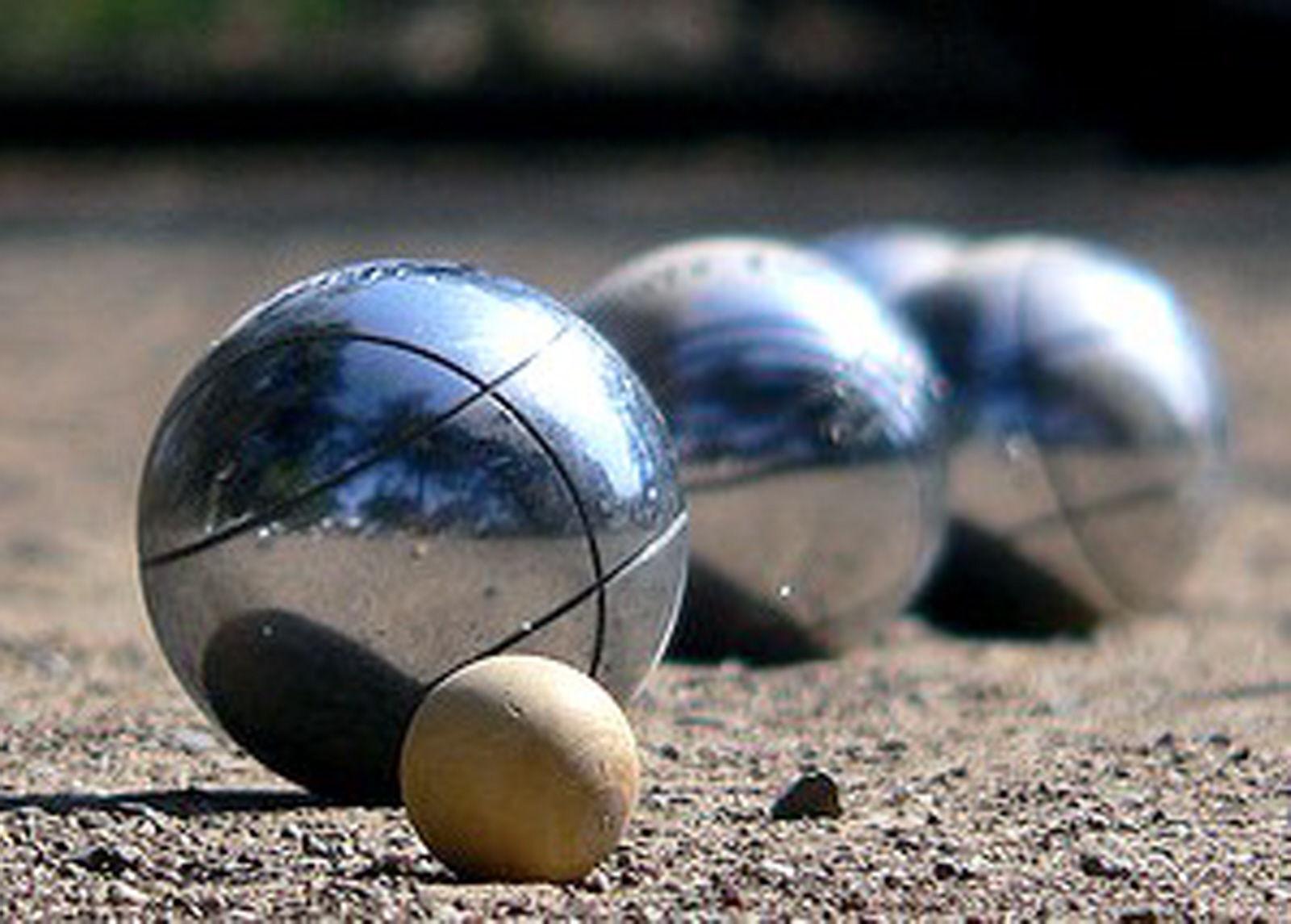
petanque
How Does Pétanque Differ from Lawn Bowls and Bocce?
While pétanque belongs to the broad global family of boules sports, confusing it with lawn bowls or bocce is a common mistake for newcomers. Understanding these structural differences clarifies why pétanque is so unique and versatile across different playing surfaces.
1. Pétanque vs. Bocce
Surface: Bocce requires a smooth, flat, flat-walled court-often made of packed dirt, artificial turf, or specialized poured resin. Pétanque, by contrast, is played on rough, open gravel, sand, or crushed stone surfaces called terrains.
Equipment: Bocce uses larger, heavier balls made of solid resin or wood. Pétanque relies on smaller, hollow steel boules.
Delivery: Bocce allows players to take a running step before releasing the ball underhand or tossing it. Pétanque strictly forbids stepping; both feet must remain motionless inside a designated throwing circle until the boule hits the ground.
2. Pétanque vs. Lawn Bowls
Ball Trajectory: Lawn bowls features asymmetrical, biased balls designed to curve widely across pristine, manicured grass greens. Pétanque boules are perfectly spherical and unbiased; they travel in a straight line or loft high through the air in a parabolic arc.
Maintenance & Facilities: Lawn bowls demands high-maintenance, ultra-smooth grass or carpeted greens. Pétanque courts require minimal upkeep and can be installed virtually anywhere with crushed aggregate.
| Feature | Pétanque | Bocce | Lawn Bowls |
| Boule Material | Hollow Carbon or Stainless Steel | Solid Resin or Wood | Solid Composite / Resin |
| Boule Weight | 600g – 800g | 900g – 1,000g+ | 1,200g – 1,500g |
| Stance at Release | Both feet stationary in a 50cm circle | Step-forward release allowed | Step-forward rolling delivery |
| Ideal Terrain | Rough aggregate, gravel, crushed rock | Smooth packed dirt, resin, turf | Flat manicured grass / green |
What Equipment Do You Need to Play Pétanque?
One of pétanque's greatest advantages is its minimal equipment requirement. You do not need expensive specialized gear to get started. To launch a match, you only need two core elements: metal boules and a small wooden target ball.
1. The Boules (Metal Balls)
Pétanque boules are hollow steel spheres manufactured from either carbon steel or stainless steel. Unlike lawn bowls, they are completely symmetrical and balanced without any biased weights.
Diameter: Official competition boules range between 70.5 mm and 80 mm in diameter to accommodate different hand sizes. Smaller boules fit tighter grips, while larger boules cover more space near the target.
Weight: Boules range from 600 grams to 800 grams.
Pointers (players specializing in precision placement) often prefer heavier boules (730g–800g) because the added mass helps plow through gravel irregularities.
Shooters (players specializing in knocking away opponent boules) often prefer lighter boules (650g–700g) to minimize fatigue during long high-arc throws.
Striations (Pattern Lines): Boules feature different engraved line patterns cut into the surface. Smooth boules slip out of a shooter's hand easily for clean, high-arching releases. Heavily striated boules provide extra grip for pointers and help bite into soft ground upon landing.
2. The Jack (Cochonnet)
The target ball in pétanque is traditionally called the cochonnet (French for "piglet"), though it is also referred to as the bouchon (stopper) or simply the jack.
Material: Traditionally crafted from dense wood (such as boxwood or beech), though synthetic resin target balls are also permitted in competition.
Dimensions: Measures exactly 30 mm in diameter (with a tolerance of +/- 1 mm).
Visibility: Modern target balls are often painted in high-visibility fluorescent colors (yellow, orange, or bright red) so players can easily judge distances from 10 meters away on grey gravel.
3. Essential Accessories
Measuring Tape / Compass: Crucial for settling tight disputes over which boule is closer to the target.
Throwing Circle: A rigid 50 cm plastic ring (or a circle drawn directly into the dirt with a stick).
Wiping Cloth (Chiffon): Used to clean dust and moisture off steel boules between ends.
How Do You Set Up a Pétanque Match and Court?
Setting up a match takes under five minutes once you have a suitable surface. Understanding team formats and court specifications ensures fair play.
Team Formats and Boule Allocations
Pétanque can be played in three standard match configurations. Regardless of format, a full game involves 12 boules total on the court.
Singles (Tête-à-tête): 1 player vs. 1 player. Each player plays with 3 boules (6 total).
Doubles (Doublette): 2 players vs. 2 players. Each player plays with 3 boules (12 total).
Triples (Triplette): 3 players vs. 3 players. Each player plays with 2 boules (12 total).
Court Dimensions and Terrain Construction
Pétanque is famously forgiving of rough terrain, but formal courts follow specific guidelines:
Official Competition Dimensions: 4 meters wide by 15 meters long (13 ft × 49 ft).
Casual / Social Dimensions: 3 meters wide by 12 meters long (10 ft × 39 ft) works exceptionally well for backyards or public parks.
Surface Specification: The ideal terrain consists of a hard-packed base layer (like crushed road base) topped with a 15–25 mm topping of fine gravel, decomposed granite, or crushed limestone (grain size between 6 mm and 10 mm). This creates an unpredictable, high-friction surface that rewards lofted throws over low rolls.
What Are the Essential Rules of Pétanque?
The fundamental objective of pétanque is simple: get your team's boules closer to the cochonnet than your opponent's closest boule.
Step 1: The Coin Toss and Circle Placement
A coin toss determines which team throws first. The winning team draws or places a 50 cm throwing circle on the ground. The circle must be placed at least 1 meter away from any surrounding walls, trees, or boundary lines.
Step 2: Throwing the Jack (Cochonnet)
The starting player steps into the circle and throws the cochonnet out. To be valid, the target ball must land:
Between 6 meters and 10 meters away from the front of the circle.
At least 1 meter away from any obstacle or boundary boundary.
Visible to a player standing upright inside the circle.
If the first attempt fails to land in a legal spot, the opposing team gets to place the jack by hand in a valid position, but the original team retains the right to throw the first boule.
Step 3: Throwing the First Boule
The same player who placed the jack steps into the circle and throws their team's first boule, attempting to place it as close to the target as possible.
The Golden Rule of Stance: Both of the thrower's feet must remain flat on the ground completely inside the circle until the thrown boule has touched the terrain. Lifting a heel or stepping on the ring results in a foul.
Step 4: The "Farthest Away" Rule
This is the central engine of pétanque tactics: the team whose best boule is farthest from the jack must keep throwing until they gain the point (holding the lead) or run out of boules.
Scenario: Team A throws a boule 20 cm from the jack. Team B steps up and throws, but their boule lands 35 cm away. Because Team B is still farther from the jack than Team A's best boule, Team B must throw again.
Once Team B lands a boule 10 cm from the jack, Team B now "holds the point." Control immediately switches back to Team A, who must step up to throw.
When one team exhausts all their boules, the opposing team steps into the circle and throws all of their remaining boules to score additional points.
How Does Scoring Work in Pétanque?
Once all 12 boules have been thrown by both sides, the end (known in French as a mène) is complete, and points are scored.
Counting the Points
Only one team can score points in any given end-specifically, the team with the single boule closest to the cochonnet.
Identify the boule closest to the jack. The team that owns this boule wins the end.
Count how many boules belonging to the winning team are closer to the jack than the single best (closest) boule of the losing team.
Each qualifying boule earns 1 point. The maximum score in a single end is 6 points (if one team has all 6 of their boules closer than any opponent boule).
Winning the Game
The team that won the end draws a new throwing circle around the current position of the jack and begins the next end. Matches are played continuously across multiple ends until one team reaches 13 points to win the game.
French Cultural Etiquette: If a team loses a match 13–0 without scoring a single point throughout the entire game, traditional custom dictates that they must "Kiss Fanny" (Embrasser la Fanny). Historically, this involved kissing the backside of a statue or painting named Fanny; in modern social play, it usually means buying the winning team a round of drinks!
What Are the Core Tactics: Pointing vs. Shooting?
Pétanque strategy revolves around the delicate balance between defensive placement and aggressive destruction. Teams generally split responsibilities between two specialized roles.
1. Pointing Techniques (Pointer)
Pointing is the art of pitching a boule so it comes to rest as close to the jack as possible-or blocking access to it.
The Rolling Point (Roulé): The player throws low, allowing the boule to land early and roll smoothly along the ground toward the target. Best used on flat, predictable dirt.
The Half-Lob (Demi-Portée): The player lofts the boule into an arc so it lands halfway between the circle and the jack, rolling the remaining distance. This is the most common all-around throw.
The High Lob (Plombé): The high lob is an advanced technique where the player lofts the boule high into the air with heavy wrist backspin. The boule drops nearly vertically, digging into the gravel surface and stopping almost instantly.
Strategic Blocking: If the opposing team has a master shooter, a pointer may intentionally drop a boule 30 cm to 50 cm directly in front of the jack. This acts as a physical shield, blocking the shooter's line of sight.
2. Shooting Techniques (Tirer)
Shooting is an offensive strike intended to smash an opponent's high-scoring boule away from the target.
Direct Hit (Tir au fer): The shooter throws a high trajectory ball that hits the target boule directly in the air without touching the ground first, blasting it meters away.
Ground Skitter (Tir à la rafle): The shooter throws low and fast, skipping their heavy boule along the ground to sweep away cluster balls. (Note: While popular in casual play, this is often discouraged on uneven terrain).
The Carreau (The Ultimate Shot): A carreau occurs when a shooter hits the opponent's boule so cleanly and squarely that the opponent's ball is launched out of play while the shooter's own boule comes to an absolute dead stop in the exact same spot. It is the most thrilling shot in boules sports!


