

Launching or expanding a commercial lawn bowls operation requires balancing player experience with inventory efficiency. Whether adding lawn bowls to an existing country club, integrating a grass green into a resort, or opening a high-volume social "eatertainment" venue, outfitting the facility involves more than simply buying a few sets of bowls.
Operators must distinguish between high-demand core inventory and secondary accessories. Over-purchasing niche sizes leads to dead capital sitting on shelves, while under-investing in proper surface infrastructure or measuring tools creates operational bottlenecks during peak hours.
This practical procurement guide breaks down the essential equipment required to run a commercial lawn bowls venue, detailing fleet sizing distributions, rink gear, surface maintenance tools, and revenue-generating accessories.
What Core Equipment Is Required for the Playing Fleet?
The primary capital expense in equipment procurement is the rental fleet. Lawn bowls are sold in matching sets of four, engineered with a specific bias that causes them to curve as they lose momentum. Unlike standard ten-pin bowling, where balls are selected purely by weight and finger-hole size, lawn bowls involve three key variables: size, weight, and grip.
For a commercial operation catering to corporate events, casual social leagues, and club members, stocking the right distribution is critical.
Fleet Sizing Distribution Guidelines
Light / Small Sizes (Size 00–0): Represents 25% of fleet inventory. Best for corporate events, beginners, juniors, and players with smaller hands.
Medium Sizes (Size 1–2): Represents 50% of fleet inventory. The core workhorse fleet suitable for the average adult player.
Large / Heavy Sizes (Size 3–4): Represents 25% of fleet inventory. Tailored for experienced players and male league members.
Key Equipment Specifications
Size Distribution: Lawn bowls range in size from Size 000 (smallest, lightest) to Size 5 (largest, heaviest). For commercial venues, sizes 00 through 3 represent 85% of total play volume.
Weight Profile: Modern commercial fleets rely almost entirely on Heavy or Extra Heavy density profiles within each size class. Heavier bowls handle wind resistance on outdoor greens and maintain true line trajectories on varied green speeds.
Grip Ergonomics: Casual and social players frequently struggle with bowl slipping during release. Fleet buyers should prioritize ergonomic grip patterns such as deep-groove or micro-grip options.
Fleet Inventory Allocation Matrix
For an 8-rink facility capable of hosting up to 64 players simultaneously (8 players per rink in traditional rink play or doubles formats), venues should maintain a minimum of 20 to 24 full sets (80–96 individual bowls) to allow seamless rotation, cleaning, and staging between event bookings.
| Equipment Item | Quantity (8-Rink Venue) | Target Specification | Commercial Function |
| Core Bowls Fleet | 20–24 Sets (80–96 Bowls) | Sizes 00 to 3; Deep-Groove Grip; Heavy Density | Primary rental gear for social and league play. |
| Youth/Beginner Sets | 4–6 Sets (16–24 Bowls) | Size 000 / Rubberized Training Bowls | Fits smaller hands; reduces wrist strain for novices. |
| Target Jacks ("Kitties") | 12 (8 Active, 4 Spares) | Solid Composition; High-Visibility Yellow or White | Core target ball required for every end played. |
| Delivery Mats | 10 (8 Active, 2 Spares) | Heavy-Duty Non-Slip Vulcanized Rubber | Protects turf at delivery point; marks foot position. |
What Rink and Match Accessories Are Essential?
Once the core fleet is established, the next priority is outfitting individual rinks. Rink accessories govern gameplay flow, scorekeeping, and officiating close ends.
1. Delivery Mats and Target Jacks
Every active rink requires one delivery mat and one target jack per end.
Mats: Commercial mats must feature heavy, textured rubber bottoms to resist sliding on wet grass or slick synthetic turf. White or high-contrast borders help players position their feet legally.
Jacks: High-visibility yellow has largely replaced traditional white jacks in commercial venues because yellow offers better contrast under night LED floodlighting and in photo/video captures during corporate events.
2. Measuring and Marking Equipment
In lawn bowls, determining which bowl is closest to the jack frequently comes down to fractions of an inch. Umpires and event hosts require reliable measuring tools to resolve disputes quickly and keep games moving.
String Measures (Flexible Callipers): A standard 9-foot or 11-foot retractable string measure with a built-in peg is the most common tool for measuring short distances between bowls and the jack.
Telescopic & Laser Measures: For longer distances across the green, venue staff should keep two telescopic measuring rods on hand.
Spray Chalk (Toucher Markers): Water-based chalk spray is used to mark bowls that touch the jack during delivery ("touchers"). Water-based formulas wash off automatically upon contact with wet grass or during routine wiping, leaving no permanent residue on acrylic or resin surfaces.
3. Scoreboards and Boundary Indicators
Clear visual scoring enhances the spectator experience and helps corporate groups track competition progress.
Flip Scoreboards: Portable, dual-sided flip scoreboards mounted on metal stands at the end of each rink display the rink number, current end, and accumulated points for home and away teams.
Boundary Pegs and Rink Numbers: Boundary markers clearly define the width of each rink (typically 14 to 19 feet wide) to prevent bowls from straying into adjacent active rinks.
What Surface Maintenance Equipment Is Needed?
Whether operating on natural bentgrass, cotula weed, or a woven synthetic needle-punch surface, protecting the playing green is critical to protecting capital investments. Green damage directly impacts bowl speed, bias line accuracy, and venue aesthetics.
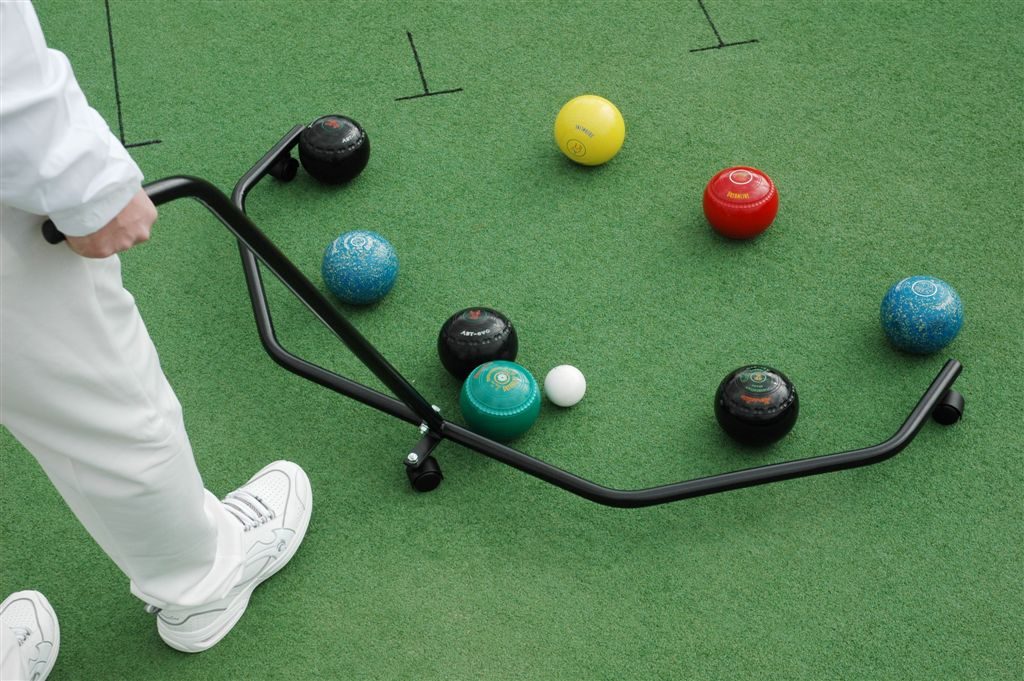
lawn bowls gatherer
1. Equipment for Natural Grass Greens
Natural grass greens require specialized turf care machinery to maintain a bowling speed of 12 to 17 seconds (measured by the time it takes a bowl to travel 27 meters from delivery to stop).
Precision Reel Mower: Standard rotary lawnmowers cannot deliver the ultra-low cut required for a bowling green (typically 3mm to 4.5mm height of cut). A 9-blade or 11-blade precision walk-behind reel mower is essential.
Heavy Turf Roller: A dedicated 1.5 to 2-ton bowling green roller smooths micro-imperfections, firms the topsoil, and increases green speed without lowering cutting heights.
Ditch Protection Liners: The ditch surrounding the green must be lined with synthetic turf, rubberized ditch mats, or coconut coir matting to absorb the impact of bowls driven off the green at high velocity, preventing chip damage to the resin composition.
2. Equipment for Synthetic Greens
Synthetic greens offer lower operational overhead but still require routine grooming to prevent fiber compaction and infill displacement.
Drag Brooms and Grooming Rakes: Tow-behind or manual drag brooms must be run across woven synthetic greens weekly to keep fibers upright and distribute sand infill evenly.
Industrial Power Sweepers: High-powered leaf blowers and rubber-tined power sweepers clean organic debris, leaves, and dirt out of the synthetic pile before debris breaks down into organic matter that fosters algae growth.
What Storage and Retail Accessories Generate Revenue?
Managing equipment lifecycles and maximizing average customer spend requires dedicated storage systems and front-of-house retail items.
1. Storage Racks and Fleet Carts
Storing 100+ bowls loosely in plastic tubs causes surface scratches, ruins bias precision, and slows down rental staging.
Tiered Mobile Storage Trolleys: Heavy-duty steel carts with padded individual slots allow venue staff to roll 12 to 16 sets of bowls directly from the storage room out to the green for large corporate bookings.
Locker Systems: If catering to local leagues or seasonal club members, installing rental lockers provides a reliable recurring revenue stream.
2. High-Margin Retail Accessories
Stocking basic accessories in the pro shop or host stand creates immediate add-on sales opportunities when social players or league members arrive.
Grip Enhancers and Cloths: Wax-based grip pastes (e.g., Grippo), spray grips, and microfiber polishing cloths carry high profit margins (typically 50–65% gross margin) and appeal to players looking for better bowl control in humid or wet conditions.
Flat-Soled Footwear: Smooth-soled shoes are strictly enforced on natural grass greens to prevent heel damage. Carrying an inventory of affordable flat-soled slip-ons or rental overshoes prevents turning away walk-in guests who arrive in boots, heels, or aggressive tread running shoes.
How Should Venues Plan Equipment Capital Expenses?
To assist hospitality operators, property developers, and club managers in budgeting, the following financial overview outlines estimated turnkey equipment costs for a standard 8-rink facility.
Initial CapEx Budget Allocation Breakdown
Core Fleet & Jacks (35%): Bowls sets, youth training sets, target jacks.
Rink Accessories (30%): Scoreboards, delivery mats, measuring gear, rink markers.
Storage & Staging (25%): Mobile storage carts, racks, member lockers.
Retail & Add-Ons (10%): Grip paste, overshoes, polishing towels.
Capital Expenditure Estimate (8-Rink Commercial Venue)
Core Rental Fleet (24 Sets + Youth Sets): $7,500 – $11,000
Rink Accessories (Mats, Jacks, Scoreboards, Measures): $3,000 – $5,000
Storage & Staging Infrastructure (Mobile Carts, Racks): $2,500 – $4,000
Pro Shop Retail Initial Stock: $1,500 – $3,000
Total Estimated Initial Gear Investment: $14,500 – $23,000
(Note: Excludes primary green construction and heavy turf care machinery such as reel mowers or rollers.)
What Is the Most Efficient Procurement Strategy?
When launching a lawn bowls venue, focusing initial purchasing on versatile, highly durable core equipment prevents capital inefficiency.
Prioritize Mid-Range Sizes: Focus 75% of your rental fleet inventory on Sizes 00, 0, 1, and 2 with deep-groove grips.
Standardize Rink Gear: Buy uniform, high-visibility yellow jacks, heavy rubber mats, and durable flip scoreboards to streamline setup and replacement sourcing.
Protect the Surface: Invest in proper ditch lining and footwear enforcement solutions from day one to preserve both your green and your equipment fleet.
By establishing an organized fleet management strategy and outfitting rinks with heavy-duty commercial gear, venue operators can deliver a high-quality player experience while keeping operational overhead and equipment replacement costs firmly under control.


