

For sports venue operators, club directors, and pro shop managers, managing a lawn bowls retail operation presents a unique commercial challenge. Unlike standard athletic footwear or apparel, stocking lawn bowls requires balancing physical sizes, engineered weight classifications, custom trajectory biases, and specialized grip profiles. Because a single high-end four-bowl set can retail between $400 and $600, misjudging customer demand can quickly tie up tens of thousands of dollars in stagnant working capital.
To build a profitable, high-margin retail operation, pro shop managers must move away from generic purchasing and implement a data-driven inventory strategy. This guide breaks down the precise mechanics of inventory allocation, sizing matrices, material durability, supplier logistics, and add-on merchandising.
1. Managing the Sizing & Weight Matrix (Sizes 000 to 5)
World Bowls standards dictate that certified competition bowls must fall within strict physical diameter tolerances, designated from Size 000 (the smallest profile) to Size 5 (the largest profile). Matching a player to the correct bowl size is the single most important step in the retail sales process. An oversized bowl causes wrist strain, grip slippage, and inconsistent delivery, while an undersized bowl leads to over-gripping and loss of trajectory control.
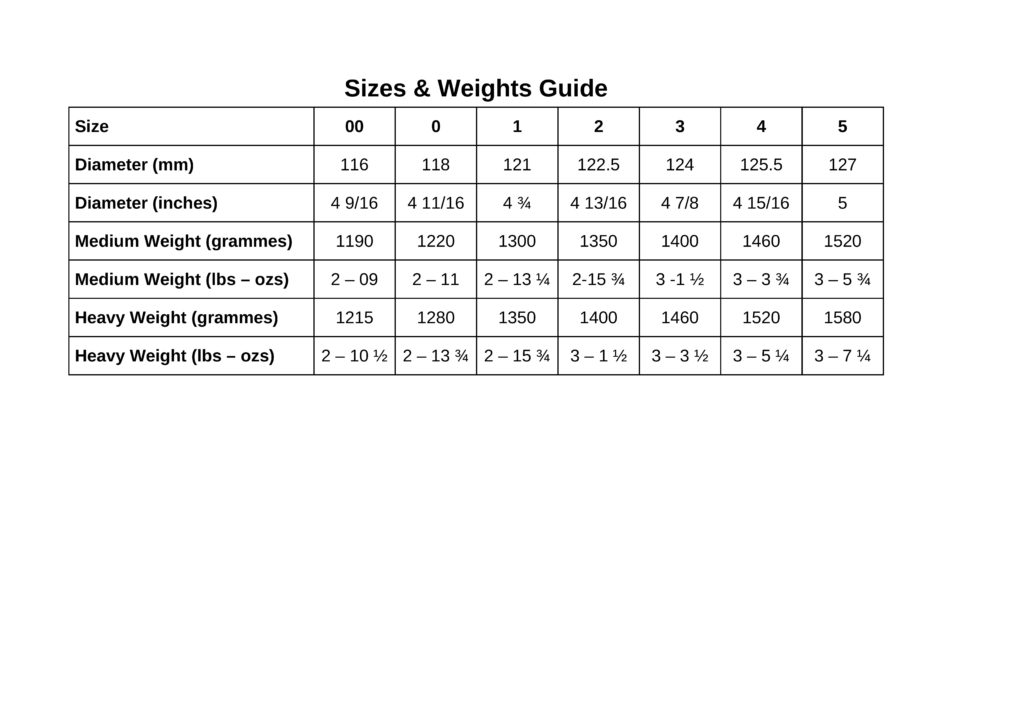
sizes and weight guide
Breaking Down Physical Diameter Tolerances
Physical size directly correlates to diameter and hand span requirements:
Size 000: ~112mm diameter
Size 00: ~114mm diameter
Size 0: ~116mm diameter
Size 1: ~118mm diameter
Size 2: ~120mm diameter
Size 3: ~122.5mm diameter
Size 4: ~125mm diameter
Size 5: ~127mm diameter
Market Demand Distribution
When planning initial inventory orders, avoid ordering equal quantities across all sizes. Demographics dictate that sales follow a distinct bell curve:
Core Demand (Sizes 2 and 3) - 60% of Total Orders: Sizes 2 and 3 fit the vast majority of adult male and female players. These are your highest-turnover SKUs and should always be kept in stock across multiple colors and bias options.
Secondary Demand (Sizes 0, 1, and 4) - 30% of Total Orders: Sizes 0 and 1 cater to players with smaller hands, junior bowlers, and older players who require reduced physical mass to maintain delivery comfort over multi-end matches. Size 4 serves larger-handed players looking for maximum stability.
Niche Outliers (Sizes 000 and 5) - 10% of Total Orders: These extreme sizes should generally be treated as special-order items rather than floor stock, preventing working capital from sitting idle on shelves.
The Market Shift to Heavy and Extra Heavy Weights
Historically, manufacturers offered bowls in Medium, Heavy, and Extra Heavy options for each physical diameter size. Today, the commercial market has shifted almost completely:
95%+ Commercial Demand for Heavy (H) Profiles: Heavy and Extra Heavy bowls carry greater mass momentum down the rink. On modern fast synthetic carpets and well-manicured grass, heavier bowls resist wind deflection, maintain linear stability, and provide superior impact force when disturbing target clusters (weighted shots).
Eliminating Medium Weight Stock: Modern pro shop managers can safely eliminate Medium weight inventory entirely, simplifying catalog management and maximizing stock turn velocity.
2. Navigating Bias Profiles, Surface Mechanics, and Grips
Understanding how lawn bowls trajectory physics interacts with playing surfaces allows pro shop staff to consult effectively, boosting conversion rates and customer satisfaction.
Mid-Bias vs. Wide-Bias Cataloging
A bowl's trajectory-its "draw"-is engineered into its asymmetrical shape during manufacturing. Pro shops must stock two primary categories of bias profile:
Mid-Bias (All-Rounder Models): These feature a gradual, predictable arc with a gentle holding finish near the end of their travel. They perform exceptionally well on fast artificial carpet, indoor needle-punch surfaces, and dry, fast grass greens (14 to 17+ seconds speed). Examples include models like the Drake's Pride Professional / Pro-50 series or Henselite Dreamline XG.
Wide-Bias (Outdoor / Slow Surface Models): Slower, heavy natural grass greens (10 to 13 seconds speed) create higher surface friction, causing bowls to stop quickly before their bias fully takes effect. Wide-bias models feature a broader arc to ensure the bowl draws around short obstacles on slower turf. A prime example is the Henselite Tiger II series.
Surface Grip Ergonomics
Modern composite bowls feature precision-milled grip patterns to help players maintain control in humid or rainy conditions. Pro shop inventory should cover three primary grip preferences:
Deep-Cut / Channel Grips: Milled channels give players tactile finger placement, reducing the squeeze pressure required during backswing.
Embedded / Ergonomic Grips: Subtle indentations along the shoulder that provide traction without altering the smooth feel of a traditional bowl.
Non-Grounded / Smooth Finish: Favored by traditionalists or players with larger hands who rely purely on surface friction and wax polishes.
3. Recommended Inventory Allocation & Working Capital Model
To optimize cash flow and prevent over-stocking, base your initial purchasing budget on an optimized capital distribution model.
Assuming a baseline inventory procurement budget of $25,000, here is how floor capital should be allocated across SKUs:
| Category / Product Group | Recommended Budget Allocation | Target Size / SKU Breakdown | Primary Customer Demographic | Expected Annual Stock Turns |
| Core Mid-Bias Sets (Heavy) | 45% ($11,250) | Sizes 2 & 3 (70%), Sizes 1 & 4 (30%) | Mainstream competitive league & club players | 4.0x – 5.5x |
| Wide-Bias Sets (Heavy) | 20% ($5,000) | Sizes 2 & 3 (80%), Size 1 (20%) | Outdoor grass green bowlers & seniors | 2.5x – 3.5x |
| Small-Hand Sets (Heavy) | 10% ($2,500) | Sizes 00 & 0 (100%) | Female players, juniors, and older members | 2.0x – 3.0x |
| Accessories & Care Gear | 15% ($3,750) | Gripping waxes, polishes, measuring tapes, cloths | All active players & visiting tournament guests | 6.0x – 8.0x |
| Bags & Footwear | 10% ($2,500) | 2-bowl & 4-bowl carry bags, flat shoes | New players purchasing complete gear packages | 3.5x – 4.5x |
4. High-Margin Add-On Accessories & Merchandising Strategies
While new bowl sets generate solid dollar revenue, high-volume accessories deliver higher percentage profit margins (often 45% to 60% gross margin). Merchandising these items directly at the point of sale (POS) increases average order value (AOV).
Essential Retail Accessory Categories
Precision Measuring Tools: Every competitive bowler requires a certified measure. Stock string measures, calliper tools, and flexible tape measures.
Grip Waxes & Sprays: Polishing waxes and liquid grip sprays maintain bowl traction and restore outer luster. Place countertop displays near the register for impulse buys.
Carrying Bags & Travel Cases: Offer a progression of bags, starting from basic 2-bowl carry totes up to heavy-duty 4-bowl rolling travel cases featuring separate shoe and apparel compartments.
Approved Flat-Sole Footwear: World Bowls requires heel-less, smooth-soled shoes to protect delicate green surfaces. Stocking dedicated bowling shoes creates a turnkey solution for new club members.
5. Establishing a "Try-Before-You-Buy" Demo Program
The single most effective tool for driving high-ticket bowl sales is a formal Pro Shop Demo Program. Because bias performance is heavily influenced by a player's unique delivery style and the specific speed of a venue's greens, players are often hesitant to spend $500+ without testing gear on the green first.
Structuring a Profitable Demo Fleet
Dedicated Demo Sets: Reserve 4 to 6 core sets (predominantly Sizes 2 and 3 in popular mid-bias models) strictly for demonstration. Clearly mark these sets with custom engraved "DEMO" stamps or distinct bright color rings.
Rental Fee / Credit Structure: Charge a nominal fee (e.g., $15–$20) for a 24-hour demo rental or a 1-hour structured practice session on the venue rink. Apply 100% of the demo fee toward the purchase of a new set if the customer buys within 14 days.
Security & Liability Terms: Require a signed demo agreement and a credit card pre-authorization covering the full retail value of the set to protect against theft or unreturned gear.
6. Supplier Logistics, Custom Orders, and Drop-Shipping
Carrying every available color combination, emblem design, and size in-house is financially unfeasible. Major manufacturers like Aero, Henselite, Taylor, and Drake's Pride offer thousands of custom emblem and multi-tone color options.
Implementing a Hybrid Inventory Model
To maximize retail revenue while controlling overhead, adopt a hybrid fulfillment workflow:
Stock the Basics In-House: Keep core physical sizes (Sizes 1–4) in classic single-color or high-demand duo-tone colors in the shop for immediate purchase.
Leverage Manufacturer B2B Portals: Utilize manufacturer digital configurators on a shop tablet. When a customer wants a bespoke laser-engraved personal logo, custom tri-band color scheme, or specialized size, process the custom order through the portal.
Collect Upfront Deposits: Require a 100% payment on custom orders or a non-refundable 50% deposit before placing bespoke manufacturing orders to eliminate abandoned custom stock.


